

PEEK5600GF30
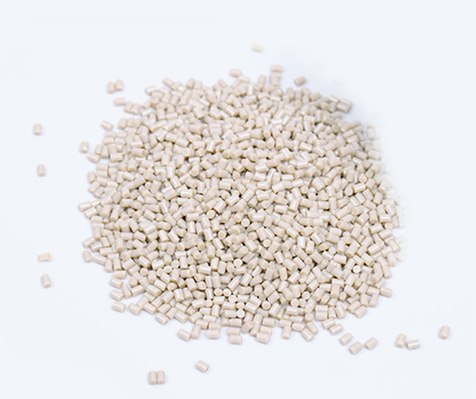
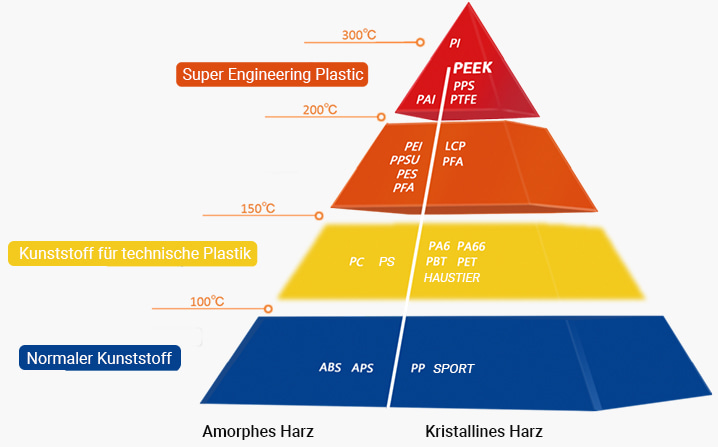
Compared with unfilled PEEK(PEEK5600G), this 30% glass fiber reinforced PEEK material(PEEK5600GF30) exhibits increased mechanical strength and high rigidity. Plus, improved creep strength and dimensional stability are delivered by the 30% glass fiber filled PEEK.
OVERVIEW
The most commonly used glass fiber filled peek content is 30%. The name of this material is PEEK5600GF30. Compared with PEEK unfilled, the PEEK material filled with glass fiber can improve higher hardness, strength and better heat resistance. The thermal deformation temperature of PEEK filled with glass fiber can be increased from 160℃ to over 300℃. Compared with this, the disadvantages of glass fiber modification are that it is more difficult to process, and the toughness and electrical properties are decreased compared with PEEK unfilled.
What is PEEK?
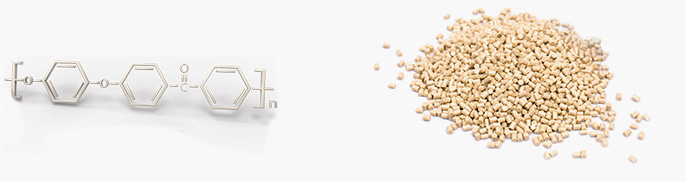
Poly (ether ether ketone)(PEEK) is a linear polymer whose main chain is composed of Aryl, ketone and ether bonds. PEEK has a large number of benzene rings in its molecular chain, so its heat resistance can match that of polyimide, while two ether chains and a renegade group provide the material with flexibility and excellent workmanship.The structure is as follows:
Advantages

High Temperature Performance
Suitable for continuous-use temperatures up to 260°C (500°F). Glass transition temperatures up to 143°C (289.4°F).

High Wear Resistance
Low coefficient of friction. High abrasion and cut-through resistance.

Mechanical Strength and Dimensional Stability
High strength and stiffness in demanding conditions. Excellent long-term creep and fatigue properties.

Resistance to Harsh Chemicals
Withstands a wide range of acids and bases and shows excellent performance in hydrocarbons and organic solvents.

High Electrical Integrity
Withstands a wide range of acids and bases and shows excellent performance in hydrocarbons and organic solvents.

High Purity & Bio Inert
Withstands a wide range of acids and bases and shows excellent performance in hydrocarbons and organic solvents.
What Industries are PEEK used in?
At present, PEEK is widely used in the fields of petroleum, food processing, automobile and aerospace because of its excellent electrical, mechanical, high temperature and corrosion resistance.

Aerospace

Food

Mechanics

Medicine

Oil and gas

Semiconductors
PEEK Manufacturing Plant
We started the PEEK polymerization project in 2014 and completed the pilot test in 2016. In 2018, Shandong Junhao HPP Co., Ltd. was officially established in Jining, Shandong Province, China, to carry out industrial production of PEEK polymerization, and finally in 2019, we complete the production of PEEK industrial chain.
PEEK Material and Types of Its Modification
Blending modification is usually the most commonly used modification method for PEEK materials. Generally, fibers, metal oxides, inorganic fillers and other high molecular polymers such as PTFE can be added to the raw materials. The PEEK composite material prepared by this method can improve the defects of PEEK by using the composite effect, and improve the comprehensive properties of the material to a great extent.
The glass fibres play a reinforcing role in the components, while their inherent non-conductivity is suitable for use in materials with high insulation requirements and high rigidity.
According to the liquidity, it can be subdivided into: PEEK3600GF30; PEEK5600GF30; PEEK7600GF30.
PEEK3600GF30 is a high mobility pure PEEK particle, and PEEK7600GF30 is a low mobility PEEK particle.
| Item | Test Standard or Instrument | Unit | (PEEK+30%Glass fiber)PEEK3600GF30 | (PEEK+30%Glass fiber)PEEK5600GF30 | (PEEK+30%Glass fiber)PEEK7600GF30 |
|---|---|---|---|---|---|
| Tensile strength (23 ℃) | ISO-527 | MPa | 163 | 162 | 163 |
| Tensile modulus (23 ℃) | ISO-527 | GPA | 11 | 11 | 11 |
| Tensile elongation (23 ℃) | ISO-527 | % | 3.4 | 3.3 | 3.3 |
| Bending strength (23 ℃) | ISO 178 | MPA | 248 | 247 | 247 |
| Bending modulus (23 ℃) | ISO 178 | GPA | 9.5 | 8.9 | 8.9 |
| Compressive strength (23 ℃) | ISO 604 | MPA | 248 | 248 | 248 |
| LZOD notched impact strength | ISO 180/A | KJ/㎡ | 55 | 57 | 57 |
Process with Ease When Specifying PEEK High-Performance Polymers
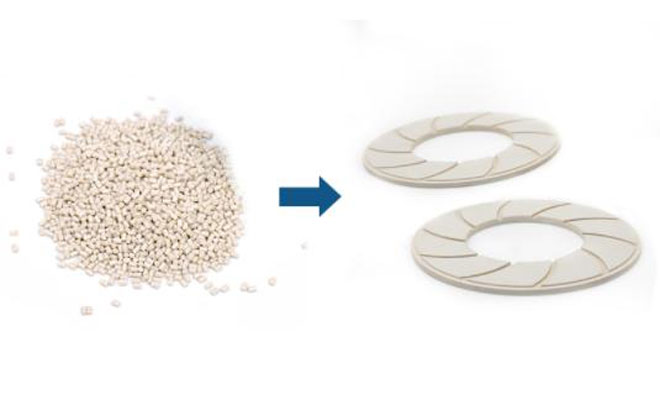
PEEK polymer is capable of being processed on conventional thermoplastic equipment. Unfilled and filled grades may be supplied in the form of granules, powder or ultra-fine powder. Granules are generally recommended for injection moulding, extrusion, monofilament and wire coating operations. Powder is used for compression moulding whilst fine powders are generally used for coating processes and composite pre-preg manufacture.
Injection Moulding
Most standard reciprocating screw injection moulding machines are capable of moulding unfilled and filled PEEK grades. Complex and intricate high performance components can be mass-produced without annealing or conventional machining. technical experts can assist with design and process variables such as machine design, barrel capacity, screw and mold design and gating.
Extrusion
PEEK thermoplastics can be used in extrusion processes and equipment including wire coating, profile extrusion, film, pipe, sheet and monofilament production. Unfilled and filled grades are readily extruded using conventional melt processing technology. Our highly experienced technical team can help define the machine design and address any processing challenges.
Compression Molding
Compression moulded parts are generally more crystalline, have a higher modulus and tensile strength and are harder with a lower ductility. Glass and carbon fibres may be combined with PEEK for compression moulding. Our technical team recommends that our customers anneal parts with very thick sections to relieve stresses.